

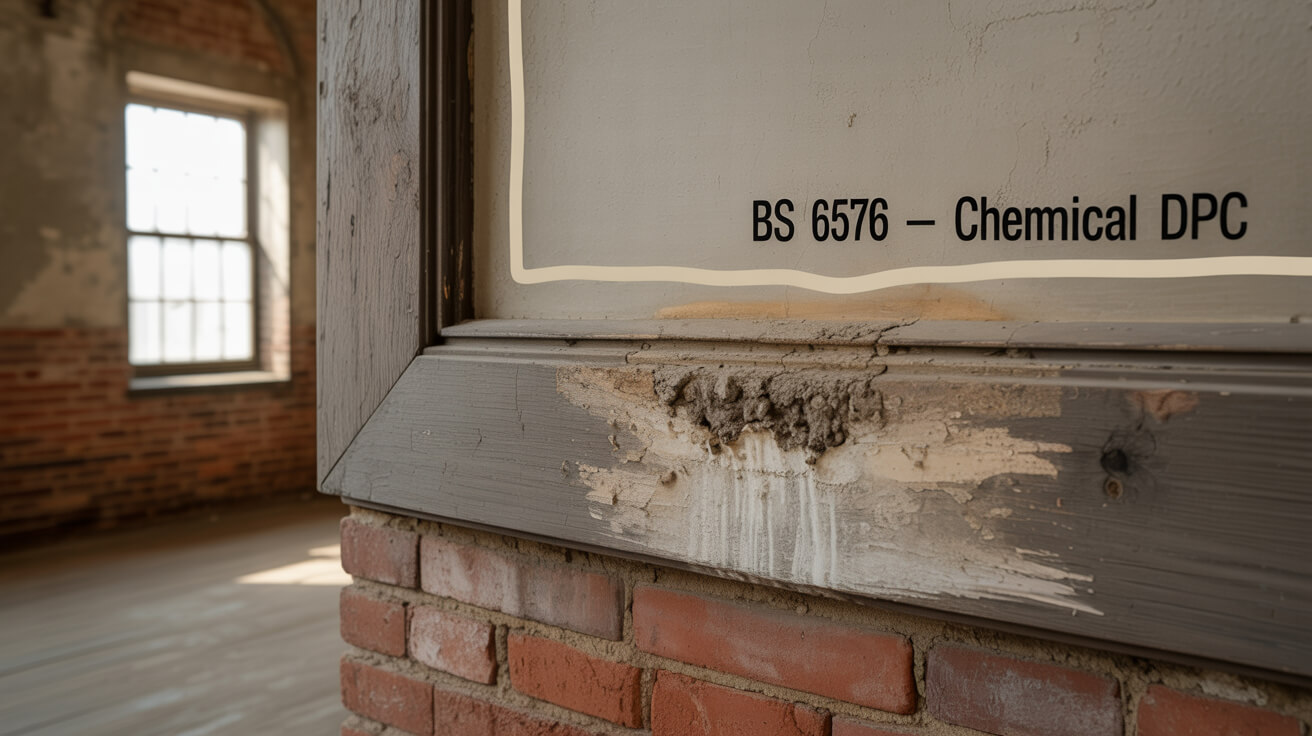
BS 6576 – Chemical DPC represents a significant evolution in damp proofing technology. Employing a precise chemical injection method, it establishes a continuous, hydrophobic barrier within masonry, thereby averting the capillary rise of moisture. In the conservation of heritage properties, this technique is uniquely poised to balance effective damp treatment with the preservation of historical fabric, addressing both the structural and aesthetic requirements that underpin heritage conservation efforts. The application of this standard is critical not only for mitigating damp-related deterioration but also for ensuring compliance with modern building regulations while respecting traditional construction.
Etymology or Name Origin
The term “Chemical DPC” originates from efforts to distinguish chemical damp proof courses from conventional physical methods. Initially, damp proofing relied on bulk materials such as bituminous layers; however, the introduction of chemically activated compounds offered a less invasive alternative. BS 6576 formalised the criteria for these chemical treatments, establishing a vocabulary that encapsulates both the innovative nature of the technology and its application within the context of modern, yet sensitive, building conservation practices. This evolution reflects the broader industry trend toward more adaptive and preservation-conscious damp proofing strategies.
Overview / Context
BS 6576 – Chemical DPC occupies a critical niche within the domain of damp proofing, particularly as it applies to heritage properties and listed buildings. The standard provides a comprehensive framework for the use of chemical treatments that effectively counteract rising damp while maintaining the integrity of historical masonry. Heritage structures present unique challenges—ranging from variable substrate compositions to stringent restrictions on physical interventions—that necessitate a specialised approach. Chemical DPC systems are designed to be minimally invasive, ensuring that the essential character and craftsmanship of historic buildings are preserved even as modern moisture control techniques are applied.
In this context, Chemical DPC must navigate the dual imperatives of technical performance and heritage sensitivity. The standard integrates diagnostic protocols that utilise modern imaging and moisture detection tools, thereby allowing conservators to tailor treatments precisely to the needs of each structure. Concurrently, adherence to BS 6576, along with complementary standards such as PAS2035 and Building Regulations, ensures that treatments are both effective and legally compliant. This balanced approach underpins the continued relevance of Chemical DPC in environments where preservation and functionality are equally paramount.
History
The management of damp within masonry has evolved considerably over the past century. Early methods, which relied on traditional damp proof courses, were often insufficient for addressing the persistent and variable nature of rising damp in older buildings. Over time, the limitations of these approaches became evident, particularly in heritage settings where conservation requirements restrict the extent of physical intervention.
Origins and Early Developments
In the early decades of the twentieth century, conventional damp proofing methods predominantly involved the application of bituminous compounds and slate or felt barriers. These early techniques were limited by their inability to uniformly penetrate porous substrates and their tendency to deteriorate under varying environmental conditions. As academic and industry research progressed, experiments with chemical compounds began to suggest that a liquid-based treatment could offer a more effective and less intrusive solution. Early prototypes of Chemical DPC were developed in research laboratories, where tests demonstrated enhanced penetration and a more durable bond with masonry materials.
Industrial Emergence and Adoption
The shift towards chemical damp proofing gained momentum with the industrial maturation of chemical manufacturing processes. By the 1970s and 1980s, intensive field trials validated the efficacy of chemical DPC systems, leading to standardised formulations and application protocols. The development of BS 6576 was a direct result of these advancements. The standard provided a unifying framework that enabled manufacturers and practitioners to work from a consistent set of technical criteria, ensuring that chemical treatments could be applied reliably across a broad spectrum of building types. This period marked the convergence of scientific research and practical application, establishing chemical DPC as a preferred method in scenarios where traditional techniques were inadequate.
Contemporary Evolution in Heritage Applications
In recent decades, the application of BS 6576 – Chemical DPC has become central to damp proofing in heritage conservation. This evolution has been driven by both technological advancements in chemical formulations and increasing regulatory scrutiny aimed at preserving historical integrity. Modern formulations now incorporate advanced polymer and resin additives, resulting in low-viscosity compounds that achieve deep, uniform penetration in porous masonry without causing damage to original materials. Furthermore, the integration of digital diagnostic tools—such as moisture metres and thermal imaging—has refined the application process, ensuring that treatments are precisely tailored to the specific conditions of heritage structures. As a result, contemporary practices embrace Chemical DPC not only as an effective moisture control measure but also as a critical component of sustainable heritage management.
Concept / Description
BS 6576 – Chemical DPC is defined by a set of technical parameters that govern the formulation and application of chemical damp proof courses. At its core, the standard prescribes the conversion of a liquid chemical compound into a durable, hydrophobic barrier that inhibits the upward movement of moisture through porous masonry.
Technical Overview and Mechanism
Chemical DPC involves the controlled injection of a liquid formulation into pre-determined drill holes along a masonry element affected by rising damp. This process is designed to achieve deep penetration, whereby the chemical reacts with the substrate to form a continuous barrier. The mechanism is predicated on the principle that, once cured, the compound exhibits both water-repellent properties and a degree of flexibility necessary to accommodate the inherent movement within older buildings. The technical rigour of BS 6576 ensures that the injection process maintains consistency in pattern, depth, and chemical exposure, which are essential for the treatment’s long-term efficacy.
Chemical Composition and Performance Characteristics
The formulations used in Chemical DPC are characterised by their low viscosity and high penetration capabilities. They typically contain a blend of polymers and resin additives engineered to bond with masonry substrates. These components provide several critical attributes:
- Adhesion and Bond Strength: The formulation is designed to adhere to the internal surfaces of the masonry, creating a robust bond that resists displacement over time.
- Rapid Curing: The chemical reaction proceeds swiftly, allowing for quick setting and minimal disruption during the application process.
- Durability: The cured compound is resistant to chemical degradation, ultraviolet exposure, and fluctuations in moisture, ensuring its longevity.
- Environmental Compatibility: While effective, the formulations are designed to be minimally invasive, reducing the risk of adverse reactions with historic materials.
Collectively, these properties enable BS 6576 – Chemical DPC to function as a reliable barrier against moisture, thus preserving the structural and aesthetic integrity of heritage properties.
Functionality / Purpose / Applications
The primary purpose of BS 6576 – Chemical DPC is to halt the movement of moisture within masonry structures, particularly where rising damp poses a serious risk to the preservation of historic buildings. Its functionality extends across multiple dimensions, addressing both the technical aspects of damp proofing and the specific needs of heritage conservation.
Practical Applications in Damp Proofing
Chemical DPC is utilised in scenarios where conventional methods are either impractical or potentially damaging to historic materials. Heritage properties, characterised by aged brickwork and irregular construction, benefit from the minimally invasive nature of chemical treatments. Unlike physical damp proof courses, which may require extensive reconstruction, Chemical DPC allows for a more refined intervention that aligns with conservation principles.
- Heritage Damp Proofing: In listed buildings and historic environments, Chemical DPC is applied to mitigate rising damp without altering the building’s external appearance or compromising its structural integrity.
- Diagnostic Integration: Prior to application, thorough diagnostic assessments are conducted using moisture metres and thermal imaging. These tools are essential for mapping moisture gradients and ensuring that the treatment is precisely targeted.
- Tailored Installation Protocols: The treatment process involves controlled drilling and strategic injection techniques that accommodate the unique properties of historic substrates. This approach helps maintain the original character of the building while achieving effective moisture control.
Comparative Analysis
When compared to traditional physical damp proof courses, BS 6576 – Chemical DPC offers several advantages:
- Non-Invasiveness: The chemical method requires smaller, less disruptive interventions, which is particularly beneficial for heritage structures where conservation of original materials is paramount.
- Uniform Barrier Formation: Owing to its low viscosity, the chemical formulation permeates the masonry more uniformly, creating as continuous, effective moisture barrier.
- Adaptability: The customizable nature of Chemical DPC allows practitioners to adjust formulations based on the specific conditions of the building and the severity of moisture ingress.
These practical applications highlight the utility of Chemical DPC in both preserving historic integrity and ensuring long-term damp proofing effectiveness.
Classifications / Types / Variants
While BS 6576 primarily addresses a standardised Chemical DPC system, variations exist that reflect differences in formulation and application based on environmental and substrate conditions. Such classifications are generally based on:
- Formulation Variants: Differences in polymer blend ratios or resin components that influence penetration and curing characteristics.
- Application Techniques: Variability in injection methods, including depth and spacing of drill holes, tailored to particular substrate types or moisture conditions.
- Performance-Based Classifications: Distinctions based on the expected durability and moisture barrier performance, especially in challenging heritage environments.
These classifications help practitioners select the most appropriate chemical DPC variant to suit the specific requirements of a heritage property while ensuring compliance with BS 6576.
Systems / Tools / Methodologies
The successful implementation of BS 6576 – Chemical DPC hinges on a well-defined system of tools and methodologies. Precision in both diagnosis and application is paramount, necessitating the following techniques and equipment:
Installation Equipment
The installation process relies on tools designed for precision:
- Injection Guns and Drilling Equipment: These tools are calibrated to create consistent injection patterns, ensuring uniform penetration of the chemical formulation.
- Measuring Instruments: Devices such as depth gauges and flow rate monitors guarantee that the chemical is applied at optimal concentrations.
Diagnostic Techniques
Accurate diagnostic procedures are essential for determining the extent of damp issues prior to treatment:
- Moisture Metres: Employed to measure the current dampness levels and monitor changes post-treatment.
- Thermal Imaging Cameras: Used to detect areas of heat loss due to moisture, providing a visual map of damp distribution.
- Salt Test Kits: These kits identify the presence of soluble salts that can indicate the severity of rising damp conditions.
Methodological Best Practices
The application of Chemical DPC under BS 6576 adheres to a set of best practices:
- Standardised Drilling Patterns: Guidelines ensure that drill holes are evenly spaced to maximise the chemical’s effectiveness.
- Controlled Injection Techniques: Procedures dictate the exact amount of chemical to be used, reducing the risk of over- or under-application.
- Post-Treatment Monitoring: Continuous or periodic checks using digital sensors and manual readings help in assessing the treatment’s long-term performance.
By integrating these systems and methodologies, practitioners are able to execute Chemical DPC treatments with a high degree of reliability and consistency in heritage settings.
Stakeholders / Entities Involved
The applicability of BS 6576 – Chemical DPC involves a diverse set of stakeholders who work collaboratively to ensure that damp proofing in heritage properties is both effective and compliant with conservation standards.
Key Stakeholders
- Conservation Surveyors and Damp Proofing Experts: These professionals conduct comprehensive assessments to determine the extent of moisture ingress and recommend appropriate treatment protocols.
- Heritage Conservation Officers: Tasked with enforcing compliance with local and national heritage regulations, they ensure that interventions align with preservation requirements.
- Property Owners and Facilities Managers: Their primary concern is the long-term maintenance and value preservation of heritage properties. They play a critical role in commissioning and overseeing treatment projects.
- Regulatory Bodies and Standards Organisations: Institutions that develop and enforce standards such as BS 6576, PAS2035, and Building Regulations Part C offer guidance that shapes treatment protocols.
- Technical Equipment Providers: Manufacturers and suppliers of diagnostic tools and installation equipment provide essential support to ensure the quality and precision of Chemical DPC applications.
These entities collectively form a network that guarantees the practical, legal, and ethical deployment of Chemical DPC in heritage and listed buildings.
Legal / Regulatory / Ethical Considerations
The application of BS 6576 – Chemical DPC is situated within a complex framework of legal, regulatory, and ethical mandates. Ensuring compliance with these frameworks is vital for the successful execution of damp proofing treatments in heritage environments.
Regulatory Standards and Guidelines
BS 6576 is administered in conjunction with several other regulatory frameworks:
- PAS2035 and Building Regulations Part C: These standards are integral to ensuring that any damp proofing measure is compatible with wider conservation and building performance requirements.
- Listed Building Consent: For heritage structures, obtaining approval is mandatory before undertaking any damp proofing treatment. This requirement ensures that interventions do not compromise the historic integrity.
- Local Conservation Guidelines: Many local authorities provide specific recommendations or constraints regarding the methods used to treat damp in heritage sites.
Ethical Considerations
Beyond mere regulatory compliance, ethical considerations play a critical role:
- Non-Invasiveness: Treatments must be designed to preserve the cultural and historic fabric of a building, minimising visual and structural alteration.
- Reversibility: Whenever possible, interventions should allow for future reversibility to maintain the possibility of restoration to original conditions.
- Health and Safety: The chemical components used must not present undue risks to occupants or the environment, ensuring that all treatments are safe over the long term.
These legal and ethical dimensions underpin the application of Chemical DPC, ensuring that while technical performance is paramount, conservation integrity and regulatory compliance are never compromised.
Performance Metrics / Data / Measurements
The evaluation of BS 6576 – Chemical DPC applications relies on a suite of quantitative performance metrics that provide a robust assessment of the treatment’s effectiveness.
Diagnostic Measurements
The success of a Chemical DPC treatment is gauged through a range of measurements:
- Cure Times: The time required for the chemical formulation to set and form a permanent barrier is a critical metric.
- Moisture Reduction: Pre- and post-treatment moisture levels are recorded using calibrated moisture metres to ensure a significant decrease in dampness.
- Penetration Depth: The extent to which the chemical permeates the masonry is measured, ensuring that the treatment achieves a uniform barrier.
Monitoring Techniques
To ensure continued efficacy, performance metrics are often supplemented by ongoing monitoring:
- Digital Moisture Sensors: Embedded sensors can provide real-time data on moisture dynamics within treated walls.
- Thermal Imaging Follow-Up: Periodic thermal assessments help to detect any resurgence of damp phenomena.
- Visual Inspections: Routine physical examinations are conducted to assess the condition of the applied treatment and identify any degradation or failure.
These performance metrics serve as key benchmarks for verifying the successful application of Chemical DPC treatments and guiding future maintenance protocols.
Challenges / Barriers / Limitations
Although BS 6576 – Chemical DPC offers advanced treatment methodologies, its application in heritage settings is not without challenges. Several factors may impede the consistent success of these treatments.
Operational and Technical Challenges
- Installation Accuracy: The effectiveness of the treatment depends highly on the precision of the drilling and injection process. Any deviation may lead to uneven dispersion or insufficient chemical penetration.
- Variable Substrate Conditions: Heritage properties often present age-related deterioration, such as irregular masonry and degraded mortar, which may impede consistent treatment effectiveness.
- Chemical Compatibility: The interaction between certain chemical formulations and historic building materials requires careful consideration, as incompatibility can weaken structural integrity or alter appearance.
Regulatory and Heritage Constraints
- Consent Requirements: Gaining the necessary approvals, particularly for listed buildings, can introduce delays and restrict the methods available for treatment.
- Minimal Intervention Mandates: Heritage conservation principles demand that interventions be as non-invasive as possible, which may limit the scope or intensity of chemical treatments.
- Ethical Considerations: The imperative to preserve historical authenticity often necessitates a trade-off between immediate damp treatment efficacy and the long-term preservation of original materials.
Diagnostic and Monitoring Limitations
- Measurement Sensitivity: Existing diagnostic tools might not always capture the full extent of moisture fluctuations in complex heritage substrates.
- Post-Treatment Failures: In some cases, issues such as insufficient chemical curing or unexpected interactions with existing building materials can lead to treatment failure, necessitating further intervention.
These challenges underscore the importance of a well-planned, carefully monitored Chemical DPC programme that integrates both state-of-the-art technology and a deep understanding of heritage conservation requirements.
Impact / Influence / Legacy
BS 6576 – Chemical DPC has greatly influenced the field of damp proofing, particularly in its application to heritage properties. Its implementation has led to notable improvements in the preservation and maintenance of historic buildings.
Economic and Structural Impact
- Property Value Preservation: By mitigating the adverse effects of rising damp, Chemical DPC helps protect and enhance property values. The treatment prevents long-term deterioration, which can lead to costly repairs if left unaddressed.
- Structural Integrity: Maintaining a consistent moisture barrier is essential for keeping the structural integrity of older buildings intact. BS 6576 provides assurance that the treatment not only halts damp progression but also supports the long-term stability of the building.
- Cost Efficiency: Despite the initial investment, the long-term benefits of reduced maintenance and repair costs contribute to the overall economic viability of heritage conservation projects.
Influence on Industry Standards
BS 6576 has set a benchmark for chemical damp proofing, influencing subsequent standards and practices:
- Best Practices: The standard has informed industry best practices, promoting a systematic approach to diagnosis, treatment, and monitoring.
- Technological Advancements: Its emphasis on precise chemical formulations and application methods has driven further research into innovative damp proofing technologies.
- Regulatory Integration: The alignment of BS 6576 with other standards, such as PAS2035 and Building Regulations, has enhanced regulatory coherence within the damp proofing industry.
Legacy in Heritage Conservation
The legacy of BS 6576 – Chemical DPC is particularly significant in heritage conservation:
- Preservation of Historical Fabric: By offering a non-invasive treatment option, the standard supports the ongoing preservation of historic building materials and construction techniques.
- Sustainable Conservation Practices: Its integration of advanced chemical technology with minimal intervention techniques has contributed to a more sustainable approach to building preservation.
- Educational Impact: BS 6576 has also influenced architectural education and training, embedding a higher standard of care and technical rigour among future conservators and damp proofing experts.
Future directions, cultural relevance, and design discourse
The evolution of chemical damp proofing continues to generate new avenues for research, technological innovation, and regulatory development. As the field progresses, several emerging trends are poised to influence both practice and policy in the treatment of heritage properties.
Innovations and Emerging Technologies
Ongoing research is focused on refining Chemical DPC formulations to enhance both performance and environmental sustainability. Advanced polymers, nano-additives, and hybrid chemical systems promise to offer:
- Improved Penetration and Cure Times: New formulations may achieve deeper saturation and faster setting, reducing treatment durations.
- Enhanced Compatibility: Innovations aimed at reducing adverse chemical reactions with historic substrates ensure that treatments remain truly conservation-friendly.
- Digital Integration: The integration of Internet of Things (IoT) sensors and real-time diagnostic tools is expected to revolutionise post-treatment monitoring and maintenance, enabling dynamic adjustments to preserve long-term efficacy.
Critical Perspectives and Debates
Debates continue to emerge regarding the optimal balance between intervention and preservation in heritage buildings:
- Sustainable Treatment Versus Historic Integrity: While chemical treatments offer effective damp control, some critics argue that even minimally invasive methods carry a risk of altering historic materials. Ongoing studies seek to quantify these risks and develop guidelines that optimise both treatment performance and conservation ethics.
- Adoption of New Technologies: The introduction of digital monitoring and sensor-based diagnostics presents both opportunities and challenges. Stakeholders are actively engaged in discussions on how best to integrate these tools into a coherent, standardised approach that respects both technological advances and heritage preservation principles.
- Regulatory Adaptations: As innovations become more widespread, regulatory authorities are expected to update existing guidelines to allow for greater flexibility and improved effectiveness, ensuring that conservation practices evolve in tandem with technological progress.
Future Regulatory Trends and Design Considerations
Anticipated developments in regulation and design are likely to further influence the application of Chemical DPC:
- Enhanced Sustainability Standards: Future iterations of BS 6576 and related standards may incorporate stricter environmental criteria, incentivizing the use of eco-friendly formulations and practices.
- Further Integration with Digital Diagnostics: Regulatory frameworks may begin to codify the use of digital monitoring techniques, thereby standardising the methods for post-treatment assessment and ongoing compliance.
- Design Integration: As architects and conservators collaborate more closely, there is increasing emphasis on treatments that not only manage moisture but also contribute to the aesthetic coherence and cultural value of heritage properties. This convergence of design and technology is likely to produce innovative solutions that support both preservation and modern functionality.
| Aspect | Current Status | Future Direction |
|---|---|---|
| Formulation Technology | Low-viscosity, polymer-rich compounds | Nano-enhanced, eco-friendly formulations with faster cure times |
| Diagnostic Tools | Moisture metres, thermal imaging | IoT-integrated sensors and real-time analytics |
| Regulatory Alignment | BS 6576, PAS2035, Building Regulations Part C | Expanded into digital monitoring standards and sustainability criteria |
| Heritage Considerations | Minimal intervention required | Greater emphasis on reversible and non-destructive treatments |
| Stakeholder Collaboration | Diverse groups including surveyors, regulators | Integrated digital platforms fostering real-time collaboration |
This multifaceted evolution underscores the enduring importance and adaptive potential of BS 6576 – Chemical DPC, ensuring that it remains a cornerstone in the preservation of heritage buildings while accommodating future technological and regulatory developments.
